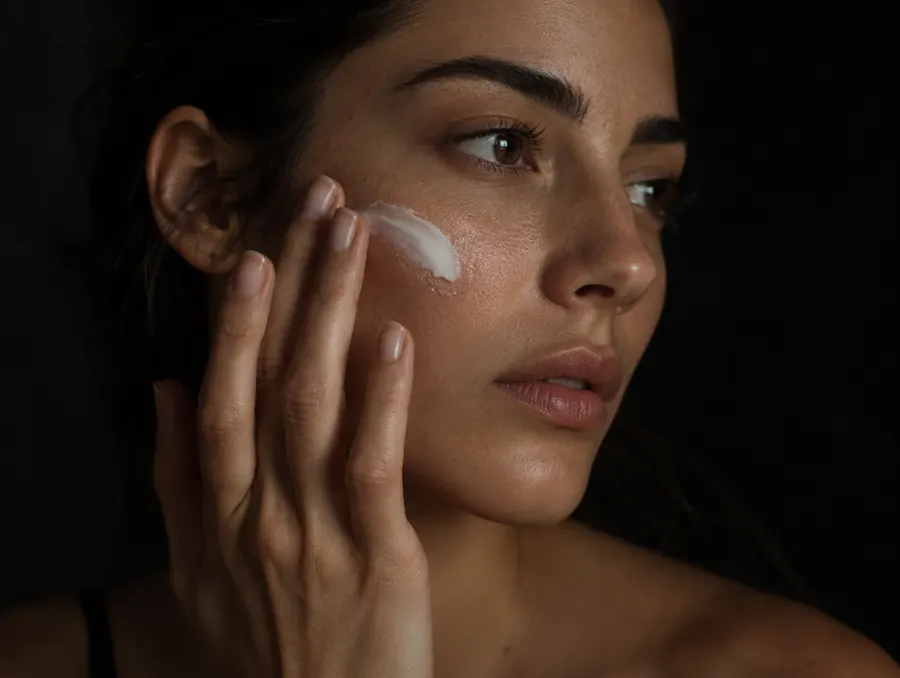
GHK-Cu is a peptide of three amino acids, glycine, histidine and lysine, bound to copper. It occurs naturally in human plasma, where it was first identified in 1973.
Published reviews report that plasma levels average about 200 ng/mL at age 20 and fall to about 80 ng/mL by age 60. On cosmetic labels it appears as copper tripeptide-1.
In a double-blind trial of about 40 women, eight weeks of GHK-Cu reduced wrinkle volume by 55.8% against a control.
Human study
Density and thickness
In a 12-week study of 71 women, a GHK-Cu cream improved skin density and thickness. Reported as an abstract.
Early human
Collagen
In a one-month pilot, collagen production rose in 70% of women using GHK-Cu.
Early human
Hair
Evidence for hair growth is early and mostly from lab and animal work. This cream is for skin.
Not yet studied
Who asks about it
People who want a physician's skincare step
Fine lines and firmness
People who notice their skin changing and want something studied in people.
No needles
People who want a peptide they apply, not inject.
Years outdoors
People whose skin has seen a lot of sun, wind and sweat.
Already have a routine
People who want to add one step, with a provider's guidance.
These describe the people who ask about GHK-Cu Cream, not results. A licensed
provider decides whether it is appropriate for you.
How it works
What it does in the body
GHK-Cu works as a signal and as a copper carrier in skin. In laboratory studies it prompts fibroblasts to make more collagen, elastin and glycosaminoglycans, and it shifts the balance of the enzymes that break down and rebuild the skin's support matrix.
A laboratory study on human skin found that it crosses the skin barrier and leaves a reservoir in the skin itself.
Copper carrier
GHK-Cu works as a signal and as a copper carrier in skin
Fibroblasts
Prompted to make collagen and elastin in lab studies
Skin barrier
Crosses the barrier and leaves a reservoir in the skin
What to expect
On the protocol
01
How it's used
A thin layer on clean, dry skin of the face and neck, once or twice daily as your provider directs. Patch test first and wear sunscreen in the morning.
02
What to pair it with
Avoid applying it at the same moment as strong vitamin C, exfoliating acids or retinoids. Use them at a different time of day or on alternate nights.
03
When to judge it
Some people notice smoother texture within a few weeks. Studies measured changes in lines and firmness at 8 to 12 weeks of consistent use.
A small copper-carrying peptide your body makes naturally. Levels fall with age. Applied to the skin, it is used to support collagen and skin repair.
Is it FDA-approved?
No. Compounded medications are not FDA-approved. It is prepared by a licensed compounding pharmacy on a provider's prescription.
How soon will I see results?
Some people notice smoother texture within a few weeks. Studies measured changes in lines and firmness at 8 to 12 weeks.
Can I use it with retinol or vitamin C?
Yes, in the same routine but not at the same time. Apply them at different times of day or on alternating nights.
What are the side effects?
Mostly mild redness, tingling or dryness. Stop and contact your provider if you develop a rash or swelling.
Will it regrow hair?
The evidence for hair is early and mostly from lab and animal work. This cream is intended for skin.
I compete in a drug-tested sport. Can I use it?
GHK-Cu is not named on the World Anti-Doping Agency Prohibited List.
What should I know before I start?
Your provider reviews your full history, so tell them about every medication and condition, including any history of cancer. Reported side effects: mild redness or tingling; dryness or itching; occasionally a rash or contact dermatitis. Who should not use it: a known allergy to copper or any ingredient; Wilson's disease or another copper metabolism disorder; pregnancy or breastfeeding, unless your provider approves; broken skin or an active eczema flare where you would apply it.
Two peptides that act on separate receptors in the pituitary gland to prompt your body's own growth hormone pulse, rather than supplying the hormone directly.
These statements have not been evaluated by the Food and Drug Administration. These products are not intended to diagnose, treat, cure or prevent any disease. Prescription products require an online evaluation with a licensed medical professional, who will determine whether a prescription is appropriate. Compounded medications are not FDA-approved and have not been evaluated by the FDA for safety, effectiveness or quality. Research cited on this site describes published studies and is not a claim about what any product will do for you. Individual results vary.